I was today years old when I learned that some people cannot see or access their mind’s eye, through a TED Talk by Alex Rosenthal, “Can you picture things in your mind? I can’t.”
Oh my! I assumed that visualizing things was a natural ability that all people have.
Imagining the rocket-ship that crash lands on a planet scenario mentioned by Mr. Rosenthal, I realized that I’m nearer to the hyperphantasia spectrum, or I if I will it, I’m in that area actually.
His talk is eye opening. He made some statements, which found me nodding my head as I listened, such as “difference is the norm,” ” diverse minds working together can produce wonders.” I found this part of his talk poetic, although I feel it was not the author’s intention: “the mind’s eye is just one of many constellations we’re starting to draw in a night’s sky full of neurological diversity.”
All right, I’ll stop discussing the talk now, but I highly encourage you to watch the video for yourself.
Instead, I will share some habits, which I recall now, relating to these concepts I learned.
When I was teaching, I’d visualize the scene in the classroom and what I needed to say. So normally, if I have gone over the material and familiarize its outline/flow, I’ll be okay without notes. That time too, when I had a full teaching load (at one point 9-10 classes in one semester, I think), I would know my students’ names, where they were seated and how they looked, by mid-semester or so. With 30-40 students per class, that’d be about 300-400 people. Again, I thought that this is something usual for everyone. But of course, that was aided by a seat plan. When there’s a quiz or a major exam which can take 30mins. or an hour maximum, I’d get bored sometimes so I used the time to recite their names mentally, while looking from left to write, row by row, aside from checking the test papers of previous classes.
I’m not sure if I still have that skill now, as my current work doesn’t demand memorizing numerous people’s names or checking and grading their outputs. But yeah, maybe I should revive that habit in some cases.
Also, I usually read several books/materials within the same period as sticking to solely one gets boring. For example, I would be in Chapter X of one fiction book, then switch to Chapter III of another, then read a factual material, and then watch a documentary, or a TED Talk like the one I just watched, and in that way, I would be looking forward to learning updates the next day or the weekend, asking questions like “What happened next?” “Did the plan succeed?” “How does it work actually,” etc.
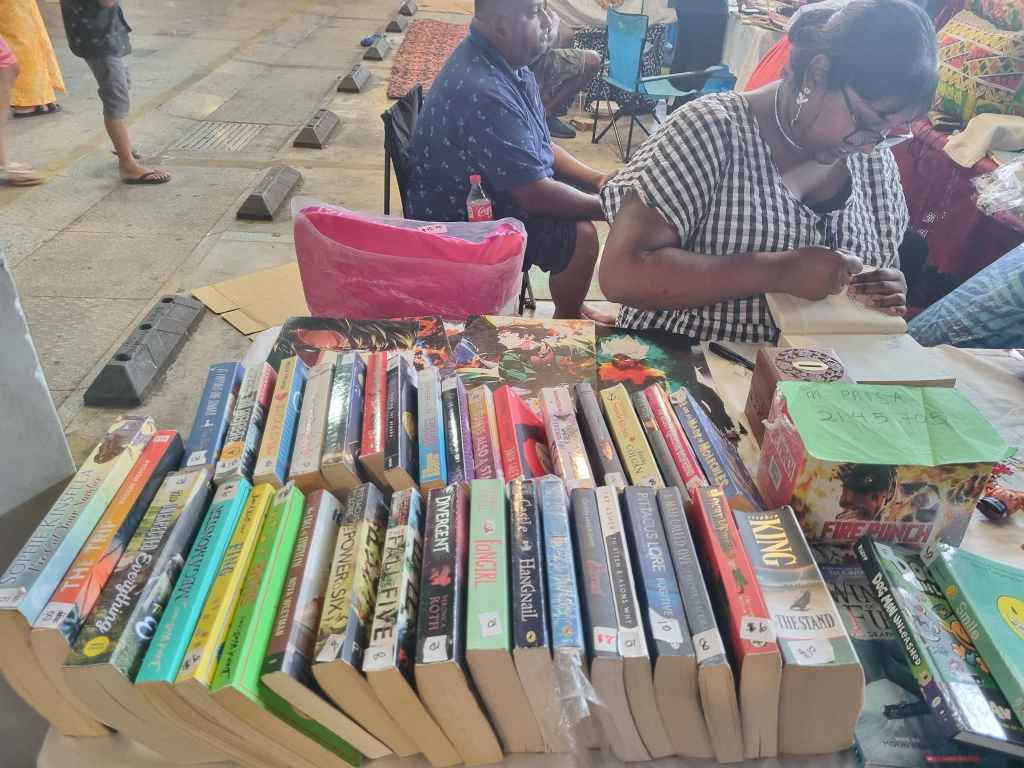
Now, I wasn’t able to bring to Suva the hardcopies of my books in my luggage, except for a small daily reflection book. They were all in a box and I thought, I could process their shipment sooner ( I was wrong). But thankfully, Sunday bazaars here have some book stalls, although most just sell a few titles. So I got these two (2), plus I was promised that I could borrow a copy of Khaled Hosseini’s books (I was only able to read “A Thousand Splendid Suns,” which I loved, and I have watched the film “The Kite Runner” both several years ago.)


I also recalled that when I was active in delivering speeches in Toastmasters (I finished my Competent Communication Norm in a year), I was so driven that I would have in my mind most of the speech content, before I had the time to write them down. The heavy traffic in Manila “assisted” in this, since commuting to and from work took hours, and being stuck in the FX or Metro didn’t allow mobility except for the mind.
In my previous Office, we did a lot of cultural projects and events. I was aware that having an expansive level of perception proved to be useful in many instances: drafting the scenario and script of events, visualizing the flow of people, imagining the overall look of the venue, providing concepts for collaterals, and more. Some ideas had to be tempered though due to budget, time constraints, number of personnel, etc.
Also, in recent meetings that required me to sit and listen for a long period, which were tests of patience, I imagined the bulleted summary forming in front of my eyes. The meetings were important, no doubt, but it could get too long and too wordy. So my mind compensated for my physical body being stuck in a chair. This has advantages, as it is already a preparation for the report drafting, but it’s not a good habit I think.
Any how, I was just really urged internally to write these thoughts stemming from the concept of aphantasia. It’s good to remember that people think differently. That would make us more open-minded and apply inclusive and diversity in the workplace, to come up with amazing outputs and to exercise patience when working together in the process.
And yes! I need to work on channeling my focus and energy where and when they’re needed. Even if it may entail curbing some near-hyperphantasia tendencies. 😀
 Beyond Routes